
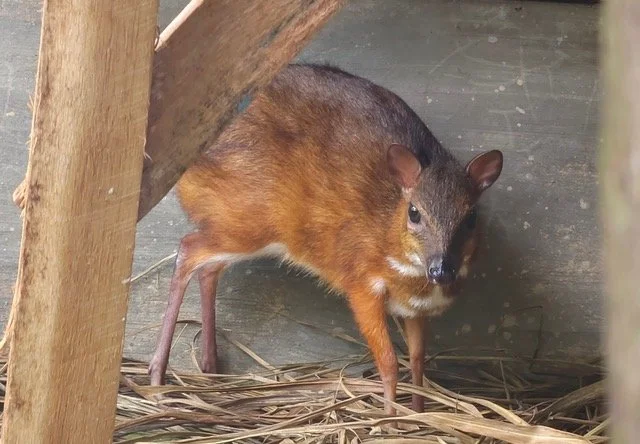
Who Are The Mouse-deers ?
Meet Mouse-deer: The Forest’s Tiny Phantom
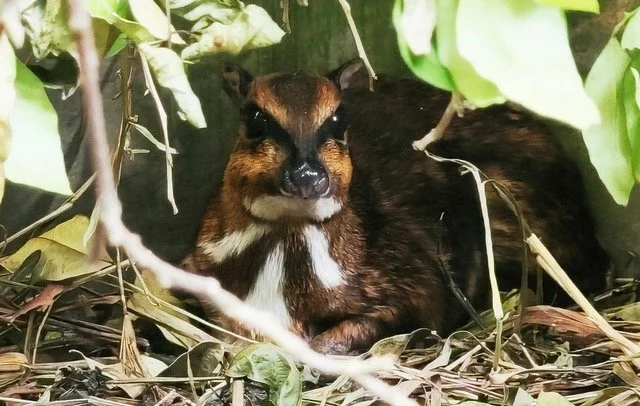
Common Name: Mousedeer / Chevrotain
Scientific Name: Tragulus spp.
Habitat: Dense tropical forests of Southeast Asia
Activity Pattern: Mostly nocturnal (active at night) and crepuscular (active at dawn and dusk)
The mouse deer, also called a chevrotain, is one of the smallest hoofed mammals in the world. Despite its name, it is not a mouse and not really a deer. Mouse deer belong to a very ancient group of animals and look like tiny, delicate forest spirits moving through the shadows. In Indonesia, species like the lesser mouse deer (Tragulus javanicus) are found in dense tropical forests.
Mouse deer are incredibly shy and secretive. They are mostly active at dawn, dusk, and during the night, quietly walking through leaf litter and undergrowth. Their small size and gentle movements help them avoid predators, and many people never see one in the wild even if they live nearby.
Instead of growing antlers like true deer, male mouse deer have long, sharp canine teeth that stick out like tiny fangs. These are used for defense and fighting with other males. Their bodies are slim, their legs are thin, and their spotted or striped coats help them blend perfectly into the forest floor.
Mouse deer feed mainly on leaves, fruits, flowers, and fallen plant material. By eating fruit and moving around the forest, they help spread seeds and support new plant growth. Even though they are tiny, they play a big role in keeping the forest healthy.
Mouse deer usually live alone. They mark small territories and prefer a quiet life away from other animals. When danger comes, they freeze in place or slip silently into dense vegetation, becoming almost invisible.
Physical Traits
One of the smallest hoofed mammals in the world
Slender body with thin legs and delicate hooves
·Short tail and small head
Males have long, sharp canine teeth instead of antlers
Brown coat with pale spots or stripes for camouflage
Diet and Behaviour
Herbivorous: eats leaves, fruits, flowers, and fallen plants
Active mainly at dawn, dusk, and night
Very shy and secretive
Lives alone and avoids other animals
Freezes or hides when threatened
Reproduction and Life Cycle
Gestation: About 140–150 days
Litter size: Usually 1 baby
Birth: Baby is small and well-hidden by the mother
Weaning: Around 2–3 months
Sexual maturity: About 5–10 months
Conservation Status
Mouse deer, also known as chevrotains, include several species with different conservation statuses. Some are still considered Least Concern because they are relatively widespread and adaptable..
However, not all mouse deer are doing well. The silver-backed chevrotain (Tragulus versicolor) from Vietnam is classified as Near Threatened, and some island populations in Southeast Asia are becoming smaller due to forest loss and hunting. As human activities increase, even species that were once common can start to decline quickly.
In Indonesia, mouse deer—especially the lesser mouse deer (Tragulus javanicus) and the greater mouse deer (Tragulus napu)—are generally listed as Least Concern at the global level because they are still found in several forested areas. However, this does not mean they are safe. In many parts of Sumatra, Java, Kalimantan, and smaller islands, their numbers are quietly declining due to increased pressure from habitat loss and hunting with snares. These animals are very small and shy, and they are often accidentally caught in traps set for other wildlife. Because they reproduce slowly and live alone, it is difficult for their populations to recover once they start to drop.
For species and populations that are already Vulnerable, survival depends on strong local protection. This is where organizations like ArkAsia Foundation play a key role—by rescuing animals from illegal situations, supporting forest protection, educating communities, and promoting coexistence between people and wildlife. Protecting mouse deer means protecting Indonesia’s forests and the many hidden species that depend on them